Writings by Nebi Vural Sensei and Nobuyoshi Tamura Sensei, reproduced from the Eurasia Aikido Organization and AikidoSphere with links to the original sources.
The roots forgotten, the tree cannot stand.
By Nebi Vural Sensei · 18 September 2025
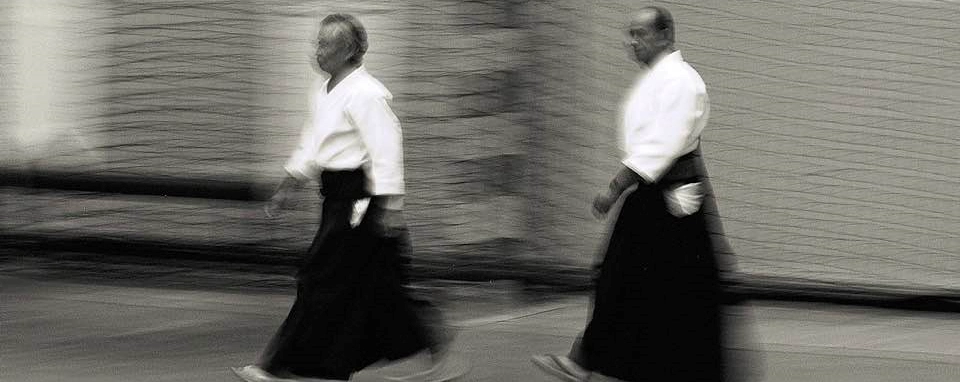
The walk of a person is not only against time; the aikidoka advances in the shadow of memories, of roots, and of stories covered by oblivion. A path without a past is like a ship with a broken compass: without direction, condemned to drift…
The past is not a time that has vanished. It is the essence of our present, the light of our future. Each memory erased is a step cast into the darkness of tomorrow. To remember is to know the depth of one’s being. The individual who forgets their past forgets themselves: they lose their identity, their value, their way.
In Aikido, this truth shines with clarity. Our techniques are not mere movements: they are the living breath of a teaching handed down from generation to generation. Every step on the way of Budō has meaning only if it follows the traces left by those who came before. To erase these traces would be to erase the way itself.
For us, one of the brightest of these footprints remains the shadow and the light of Tamura Shihan. His teaching was not only technical; it embodied a way of being, an understanding of life itself. To forget Tamura Shihan would be to forget the very heart of Aikido. Our responsibility is to bring to life the spirit that was entrusted to us.
A tree that denies its roots surrenders to the wind; but the aikidoka who draws strength from the past, the person who acknowledges their roots, remains standing before the storm. For the past is not a chain, it is a wing. It does not imprison us; it lifts us and opens the horizon.
Each time we enter the dojo, each time we step on the tatami, we are in truth bowing to the past. In that bow resound the voice of Tamura Shihan, the breath of O-Sensei, and the depth of an entire tradition. Thus must we remember:
The one who knows their past builds their future. The one who forgets it walks only in darkness.
Source: Eurasia Aikido Organization
Is Aikido still a Budo?
By Nebi Vural Sensei · 18 June 2025
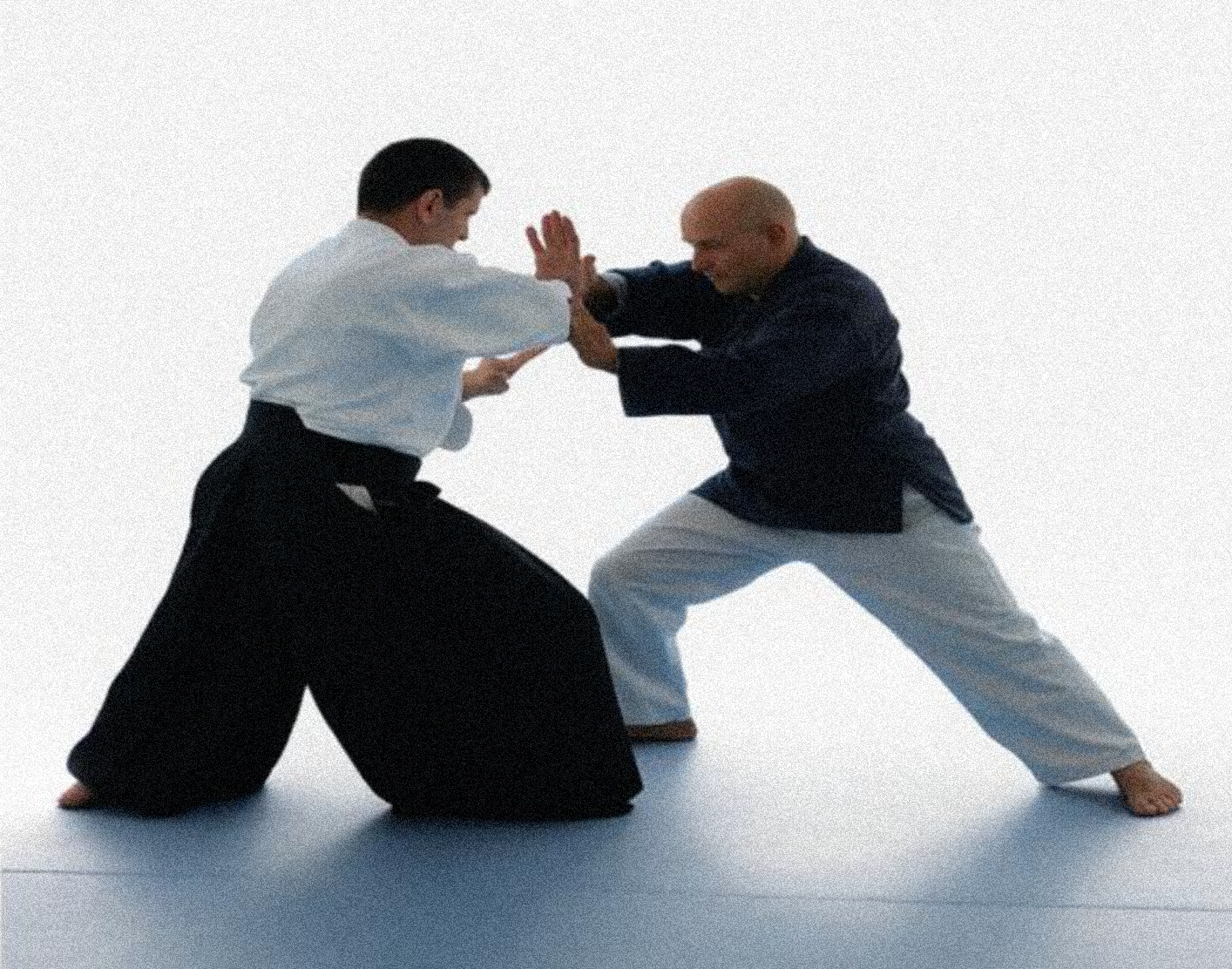
ACTION & REACTION
Is Aikido still a Budo? For us, there is no doubt: yes, Aikido is a Budo — a path of transformation, truth, and commitment. But when we look at what is being presented in some so-called “official” schools, what we see is a silent betrayal of that path.
In true Budo, every movement arises from a shared reality: Uke attacks — sincerely, with intent, with power. Tori responds — with awareness, precision, and respect for the danger. It is a dialogue of bodies and spirits, an exchange that elevates both partners.
But what is presented today as “Aikido” in these circles is nothing but a charade. The Uke has become a puppet. He falls without imbalance, follows without understanding, collapses without resistance. No arms, no legs, no will. His dignity has been stripped away. Meanwhile, the Master sits on his throne, untouchable, performing his role as dominant with arrogance, while the student fades into silence, obeys, imitates, and assumes the posture of a slave.
No more confrontation. No more risk. No more Budo. This is no longer transmission. It is submission. A soulless theater, where “respect” is just a mask worn over fear.
But Budo is not a stage set. It is a hard, demanding, sometimes dangerous path. It is truth embodied — in movement, in impact, in relationship. It is the place where a human being either rises… or breaks. True Aikido is born in that intensity. Everything else is just a comfortable illusion.
Nebi Vural
Source: Eurasia Aikido Organization
TANTŌ
By Nebi Vural Sensei · 6 March 2025
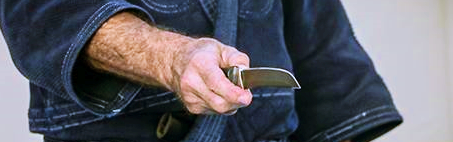
In the hands, the tantō becomes a mirror. The blade never lies. It reflects what the mind sometimes refuses to admit.
Presence. Precision. Determination.
Facing the blade, there is no room for doubt or illusion. Each movement reveals the total commitment of body and mind.
Beyond the gesture, it is a work of sincerity where the present moment becomes the only space of truth. This is where the true learning of Budo begins.
Behind each technique lies much more than a mere movement. The movement must be true. The mind, clear. The body, fully engaged.
Everyone must know their place—on the tatami, in practice, as in life. It is both a duty and an honor.
Aikido tolerates neither approximation nor forgetfulness, nor theatrics. Ease disappears where the moment imposes its law.
Facing the blade, only truth and the purity of the heart remain.
Let us train tirelessly, with sincerity and humility, for true practice begins where comfort ends.
Let us move forward together—without detour, without pause, without relent.
With respect. With strength. With heart.
Nebi VURAL
Source: Eurasia Aikido Organization
Nebi Vural: An Aikido Master Who Defies Conventions
Eurasia Aikido Organization · 9 March 2025
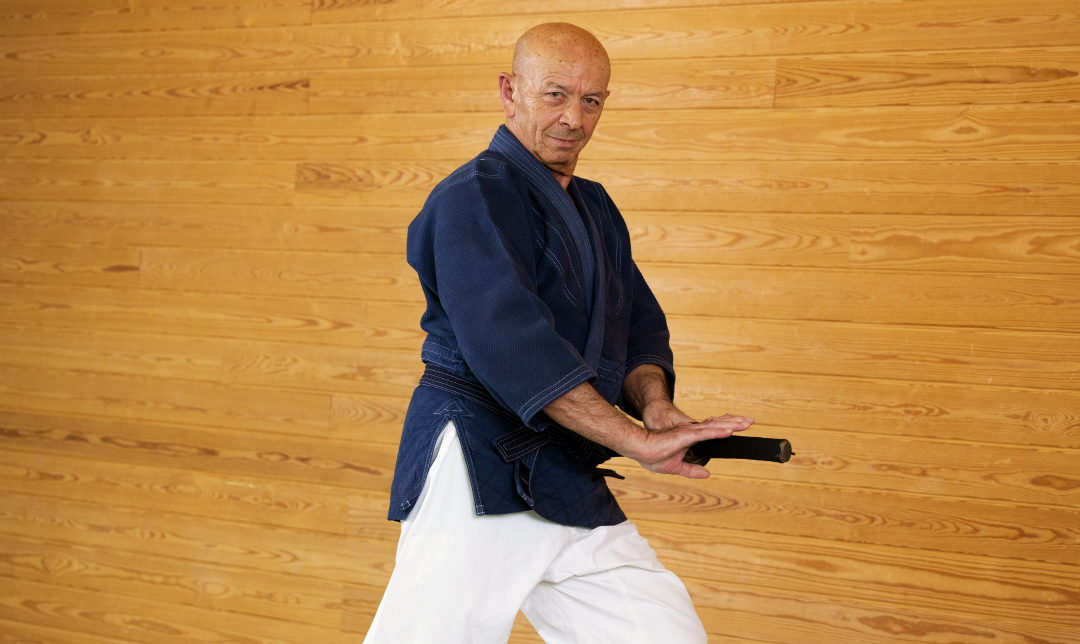
1.Who is Nebi Vural?
Nebi Vural is a globally recognized Aikido master. A direct student of Nobuyoshi Tamura, he upholds a rigorous and traditional approach to Aikido while making his teachings accessible and practical. He is often described as a disciplined, passionate practitioner with a strong personality.
Having dedicated his life to Aikido, Nebi Vural founded his own organization to spread his teachings. His approach is rooted in the fundamental principles of Budo, emphasizing sincerity and effectiveness in practice.
2. Why does he wear a navy blue keikogi and white pants instead of the traditional hakama?
Aikido attire typically follows established norms:
– A white keikogi for beginners and most practitioners.
– A black or navy blue hakama for black belts and instructors, symbolizing maturity and responsibility.
However, Nebi Vural has chosen to wear a navy blue keikogi and white pants, which often raises questions.
Possible meanings of these colors:
– Navy blue: Historically associated with samurai warriors, this color represents experience, depth, and unwavering dedication to Budo. It is also seen as a color of wisdom and perseverance in martial traditions.
– White pants: White symbolizes purity, simplicity, and a return to fundamentals. It can also signify humility, a reminder that even at an advanced level, one remains a lifelong student of Aikido.
This unconventional choice may reflect:
– A desire to stand out from established conventions while staying true to tradition.
– A commitment to a purer and more pragmatic approach to Budo, focusing on effectiveness and transmission rather than imposed dress codes.
– A statement that rank or appearance should not take precedence over real practice and dedication.
3. Why is Nebi Vural viewed with skepticism by some national and international organizations?
Nebi Vural’s influence and direct approach to Aikido do not always align with the interests of some official institutions. Several factors contribute to this: 1) His independence
Unlike many instructors who integrate into official federations, Nebi Vural has chosen to create and lead his own structure. This autonomy allows him to teach according to his convictions but is also seen as a challenge to the authority of major organizations.
2) His demanding and uncompromising teaching style
His Aikido is known for its intensity and strong martial foundation. He insists on total commitment, which may contrast with modern trends aiming to make Aikido more accessible and less physically demanding.
3) His strong personality and critical stance
Nebi Vural openly expresses his views on Aikido’s evolution and is unafraid to question certain institutional practices. His outspoken nature may be perceived as a critique of existing structures, leading to tensions with official federations.
4) His growing influence
By gathering a large following and offering an alternative to major federations, he has become a key figure in the Aikido world, which may be seen as a threat by some organizations.
Conclusion
Nebi Vural is a remarkable figure in contemporary Aikido, both respected and controversial. His unique choice of attire reflects his distinctive approach to Budo, combining fidelity to fundamental principles with a questioning of conventions. His independence and uncompromising teaching style make him a revered master among his students but also a subject of concern for some established institutions. Ultimately, his journey highlights the ongoing tension between tradition and evolution in the martial arts world.
Source: Eurasia Aikido Organization
Meaning and Levels of Dan Degrees
By Nobuyoshi Tamura Sensei · undated
Written by Nobuyoshi TAMURA Shihan.
1 – 初段 SHODAN – The First DAN:
SHO represents the beginning, beginner.
The body eventually begins to respond to the given commands and to produce technical forms. One can have ambiguous ideas about what Aikido could be.
At this point, we must force ourselves to apply the techniques as precisely as possible and to train accurately.
2 – 弐 段 NIDAN – The Second DAN:
While more intense mental continuity is being revealed, at the same time strength and speed are added to the first dan rank. This progress perceived by the student as self-development.
The jury should feel this evolution noting that the work has entered a certain way and is moving towards a certain direction.
3 – 参段 SANDAN – The Third DAN:
This is the stage where kokyu and ryoku concepts are begun to be understood. It’s the spiritual dimension of Aikido. Technical delicacy, sharpness, and efficiency begin to manifest themselves. The student reaching this point can start to train beginners.
4 – 四段 YONDAN – The Forth DAN:
At this technically advanced level, the principles that guide the techniques are begun to be comprehended. It is possible to fill in for the Sensei when it is necessary.
5 – 伍 段 GODAN – The Fifth DAN:
The art of Aikido is being liberated from the physical obstacles while it passes beyond one’s spiritual being.
6 – 六 段 ROKUDAN – The Sixth DAN:
As techniques become state of the art, movements are fluent and solid. The person who follows her/him must feel the serenity of the progress. Strength and physical flexibility just like the purity of the spirit merge into behaviors and express itself in life.
7 – 七 段 NANADAN – The Seventh DAN:
One is liberated from the obscuration of self-being and converge into his true self without any devotion to worldly pleasures.
8 – 八段 HACHIDAN – The Eighth DAN:
Beyond life and death, with a clear and open mind, in the ability to bring the opposites together, s/he refuses to fight, refuses to have enemies. Unguided and uninvited, s/he is the eternal winner. It is explained with the words of O Sensei
“To face the enemy, I just have to stand without saying a word.”
This is not the stage that everything ends. One should remember the soul of a beginner. Even the brightest water can disappear in a marsh.
Basic Concepts to know for Dan Degrees
| ARUKIKATA | The way one walks |
| KAMAE | The guard, basic position |
| KIRYOKU | The willpower, energy or vitality |
| KOKORO NO MOCHI KATA | Control of the senses |
| KOKYU | Breathing |
| KOKYU RYOKU | Breath power |
| KO RYOKU | Efficiency |
| MA AI | Distance and timing |
| METSUKE | Mental and physical sight |
| NICHIJO NO TAIDO | Everyday attitude |
| REIGISAHO | The etiquette |
| SEISHIN JOTAI | The state of mind |
| SHISEI | The posture |
| SOKUDO | The pace |
| TAI SABAKI | Movement and settlement of the body from one certain point to another |
Source: Eurasia Aikido Organization
BUDO
By Nobuyoshi Tamura Sensei · undated

This article was first published in AikidoEurope, the publication organ of the Europen Aikido Federation. The article was taken from the English text on the aikidosphere.com website.
Nobuyoshi Tamura, Shihan, 8th Dan

At present, many Budos are thriving in Europe as in America with more and more participants. For participants in Budo such as we this should be a cause for rejoicing.
However all these Budos, so different one from another, which are appearing suddenly astonish me and leave me perplexed. I am not talking of the former Budos, which rediscover the light long since hidden, and which today are judged better than they were before. This on the contrary comforts and pleases me. But rather of the Budos which mix and add one martial art with another and which are full of the colors and mysterious perfumes of the orient.
If it is true that man in society is constrained to change this society in order to adapt it for each generation because the world is in movement, it is as normal as changing techniques, culture, and civilization. It is the very condition for existence. So Budo equally may be changed in its form. But is it good to change a Budo so fundamentally?
In Japan, one says that you cannot graft bamboo onto an ordinary tree. If by chance such a grafting should succeed what would be the result: a tree or bamboo? What would you call it?
This proliferation of the martial arts in the West is to be explained perhaps by the fact that Westerners frequently do not have a good conception of the Budos. It is true that I myself am not capable of giving a good explanation of what a Budo is. The history of Budo is two thousand years old. During these two thousand years Budo, depending on the era, the region, the men, has certainly presented many faces. However, at the bottom of the heart of each Japanese lives today in our time a profound sense of Budo and as a Japanese, I can perhaps try to give you an explanation which may be of use to you.
Originally BU = ways of armed combat; thus, the method of killing, the method of war. Later BUDO = way of maintaining peace, the method of awakening in men the sense of life. Combat has changed its aim. Is this quite certain? The origin of the word soldier is to be found with the Romans in the expression: he who receives salt, later he who receives pay, that is to say, who is paid for.
In Japan, we say MONO NO FU the armed man. MONO = armed FU = man. With the same meaning TSUA MONO (TSUA = TSUBA). We also say MASURAO, a man of valor, of quality. Man of war superior to another warrior. Then with time, we arrive at Samurai or BUSHI, man of war of whom the principle characteristic is loyalty. BUSHI, man of war whose loyalty lasts until the body is crushed and the bones become brittle. The study of Bushi is thus the defiance to death. His choice: death without regret, without attachment to life. The meaning of his life is in giving his life. To safeguard the life of the head of the household to which he belongs. Such is BUSHlDO or the path of BUSHI. For us, Japanese BUSHI is the perfect image of man.
Let us continue our interpretation.
In a society, he who bears arms is undoubtedly very strong. It would be easy for him to use this power to the detriment of others. Everyone normally has affection for himself. It is therefore difficult for him to master his ego to vanquish his desires. He must be strong.
So it is that the Samurai or BUSHl must not only execute the martial arts but also have the profound qualities of spirit in order to be ever better. He must envelope himself like a second skin with moral culture. This everyone must be able to see, perceive. For we Japanese in fact, the Samurai is he who carries in everyday life the totality of qualities acquired. Thus the Samurai approaches well the perfect type of man.
Let us explain.
Merely to be physically strong, skilled at arms, signifies nothing important. The attitude, the general bearing characterizes even in defeat the true SAMURAI. Thus in the middle ages after losing a war or surrendering a castle the lord would sacrifice himself and his own family on condition that his people and his subordinates be spared and remain free. In the second world war, the Emperor of Japan on meeting general MacArthur offered him, as the person responsible, his life and that of his family asking him not to harm the Japanese. Nevertheless, he had been opposed to the war from the beginning.
Such actions are for us BUSHlDO or the way of BUSHI. Is this clear?
Let us touch upon another aspect of the question.
In Europe, at the present time, many would translate BU as stopping the spear. However, the original sense of BU is translated as spear and foot; a combination of spear and foot. Thus someone who holds a lance before his foot; attitude of a man standing holding a spear, the feet foursquare on the ground, symbol of a strong man, physically strong and armed. Armed in the service of others, the country, for example, guardian of the country if you will. With this picture of the total giving of self is for the Japanese the symbol of the true man. I will explain myself and emphasize further.
Animals have teeth, claws, hooves; men have the katana, the spear; bows and arrows. To use them for oneself is to behave as the animals; to use them for peace, not for oneself is, if you will, the way of the man. It is in this sense that BU has been translated by “stopping the spear”.
But to receive blows without being able to protect oneself is not BUDO, one may not in this case say BUDO. If soldiers cannot defend their country what will become of the population?
During the last war, Norway had an army of thirteen thousand men and eighty old aircraft, a deplorable military situation. The German army occupied Norway in three days. During that same period Switzerland, a neutral country, had one hundred and eighty thousand soldiers, a hundred and twenty aircraft of recent type, and another hundred and twenty thousand older and well-trained soldiers. That was the reason for which Hitler turned towards Norway.
The BU of a country, the BU of everyone must be constantly served. We say symbolically that one must always be ready to remove the sparks that fall on the body. One must guard this capacity of intervention.
To hold the gun, defend the weak is the image of the man. But if the necessity to use this gun does not present itself it should not be used, never for the satisfaction of the ego. The good falcon keeps his claws withdrawn.
We have in Japanese two expressions: — SATSU JlNTO: saber which kills, which takes life — KATSU JIN KEN: saber which gives life. It is the same saber, it is the man who uses it. To kill within oneself the desire to kill equals saving the life of someone. This is the meaning of KATSU JIN KEN. It is I believe the meaning which O-Sensei gave to: LOVE.
The BUSHl has the courage to strike anyone, anything, anytime, anywhere, anyone evil or himself. That is certainly the true meaning of love and to possess this meaning of the word love makes the BUSHI, that is to say, someone who can use equally well SATSU JlNTO or KATSU JIN KEN thus someone who can kill if necessary. If one does not possess this faculty KATSU JIN KEN means nothing.
It is the same on the technical plane. Study leads to it. It is BUDO which makes the BUSHI. I should not like you to be mistaken on this subject.
By BUDO with the work of Bujutsu one forges the man of strong personality. We say therefore the BUDO way, abandonment of self to SERVE. BUDO discovers the ONE, discovers UNITY, Peace amongst Men.
JlNMU is the name given to the first emperor of Japan. JIN = God, MU = Bu which translates as emperor of the country of the MARTlAL ART. We must not understand martial art as meaning the art of war but in the sense of warrior and God as one, having realized the ONE belonging to God and possessing martial power. Such is the profound thought of the Japanese whence this name was given to the Emperor. Such is the true BUDO which proposes apparent contradictions: skill at arms made to kill and which construct a harmonious world, light, clean and just.
Make the two as ONE.
I hand over these talks to your reflection.
Picture: It was edited from Utawaga Koniyoshi’s Botsu’usen Chosei (1827-1830) named piece.
Source: Eurasia Aikido Organization
Educator
By Nobuyoshi Tamura Sensei · undated
The most complete planning – study, study and study again. Training every day. Revitalizing. All have their limits. Beyond them is the black hole. The darkness. Weather, accidents and illnesses are unforeseeable.
The teacher of Aikido is a leader of men of the Moses type, at least in my opinion. Incontestably Master Ueshiba was at the summit of Aikido, but we of the valley who would look to the summit of the mountain have but a small image of him. Myself, I believe in marching behind O’Sensei but only a short rest is enough to breathe for example, and O’Sensei has already moved very far away.
Thus I know the way. I see the path but things remain to be done and thus it is I do not know them.
It is a little like a Treasure Island on old maps. But on the maps of today the island is not shown which could mean it does not exist. However you know that it exists and that it conceals a treasure. Fortified with your knowledge you set off. In this case the responsibility of the captain is enormous. The sea, the currents, the weather are also obstacles which must be surmounted. Despite all the experience you may posses, unknown difficulties will present themselves. One must nevertheless go forward although the necessity for exact judgement appears, in taking a decision, for the union of all in the same direction. It is only on this condition that the aim will perhaps be achieved.
We have tried to put together all the human forces, the part that remains is that of divine intervention, which is to say that departure taken it only remains to go forward.
The captain will be a man who has the courage of his convictions, he will be experienced, intuitive, maintaining the unity of the crew himself and the crew being but one, like a father and his son for example.
The captain thinks, must think as the crew and the crew works in the captain’s way, it can not be otherwise. The captain will know how to give the appropriate orders, the crew will understand their captain.
The captain and his crew making nothing but harmony of the group and the whole may in this way attain their aim. But all this is the work of the captain.
It reminds me of the grandmaster of tea Rukyu who is accustomed to say speaking of the tea ceremony, “it is in summer like a breath of fresh air; in winter a gentle feeling of warmth, the charcoal is only there to heat perfectly the water, the tea only for the pleasure of drinking.” I will give you the secret of the tea ceremony. If you think it is easy to create I advise you to try it.
The ordinary thing, banal, apparently easy, natural to create is difficult. To make a guest happy, for he who is thirsty, you give a large bowl with much weak tea and not too hot; for he who is not thirsty a stronger tea in less quantity and hot. You act thus for the pleasure of your guests. One must follow the wishes of the guest and sense them. The frame of mind is the secret of the tea ceremony, it is the heart of the teacher of Aikido.
The teacher of Aikido knows each of the participants and their special thirst for knowledge. If their technique is good it devotes itself to improving it, if it is bad it will go on to rectify it. It’s action will meet the declarations of the Master of tea, like a pleasant sensation of freshness in summer, like a gentle feeling of warmth in winter. …
Note: reproduced as published at AikidoSphere, where the text ends mid-sentence.
Source: AikidoSphere